Tuesday, 2 September 2025

The 'Your Party' project part 3: The Challenges: The Greens

 I was originally going to write up something about how I see the various challenges for the new party, how it tackles the Labour Party, Reform UK, Gaza, but Zack Polanski's election as leader of the Green Party decided me on focusing on the relationship of the new party and the Greens. I think it presents both challenges and opportunities, it could be said that the announcement of Your Party stole some of Polanski's thunder just as he was working his campaign to become leader of the Greens, and it is also probably true that, by becoming leader, he returns the favour, gaining the media headlines for at least a short while.

Historically, certainly for well over a decade, some people in the Green Party have tried to present it as a socialist party. However, it has been a far more heterogeneous alliance of the centre and the left, sort of eco-socialists alongside environmentally committed LibDems and therefore, like Tony Benn said of the Labour Party, not a socialist party, but a party with some socialists in it. 

I must admit to having been quite dubious regarding Polanski, his previous career and political trajectory are a trifle odd, but he seems to have integrity, passion and intelligence, he's definitely of the left, but I'm not entirely sure how left, nevertheless, his election marks a leftward shift for the Greens and maybe they will become the green socialist party that had been claimed of it by its left wing.

I saw a Facebook friend posting that there should be a coalition of the two parties - I think that when the new party hasn't even been formed it is terribly premature to suggest such a thing, it may never be appropriate, however it would also be wrong to have the two parties oppose each other needlessly to the benefit of the right. We need to see the actual shape (and the name!) of the new party, its membership, leadership and policies, before any substantial alliance can be formed, we need to see how they stand in relation to each other and also need to remember a very important lesson from the 1980s.

The Social Democratic Party is mostly forgotten now, and probably not much lamented, but it was formed from dissident centrists within the Labour Party when Michael Foot was leader, they contended that Labour had lurched too far, unacceptably so, towards the left, the initial 'gang of four' Roy Jenkins, Shirley Williams, David Owen and Bill Rogers, were soon joined by other Labour MPs and enjoyed some electoral success. They formed an alliance with the Liberal Party and were seen as a moderating influence within British politics when Labour was portrayed as extreme and the Tories actually were extreme. However, by 1987, they had lost most of their seats and merged with the Liberals to form the Lib Dems in 1989. (See the wikipedia entry here for the full sordid story: https://en.wikipedia.org/wiki/Social_Democratic_Party_(UK))

A too close alliance between two parties can lead to one being absorbed by the other, and while that's not always a bad thing, the distinctiveness of each party may be lost. If it should happen, it needs to be on the basis of creating something new and bigger, which in any case is exactly what the new party is becoming from the various small groups and parties who are the founding elements of the organisation. 

If at all possible, there does need to be some kind of collaboration between the two parties, and certainly a 'non-aggression pact' over seats that could be won by one or the other party. But, and it is very important to state this, such initiatives must, must, must come from the members, not just the leadership. If a party is genuinely about a participatory democracy it needs to be generated by the members, not just a stitch-up from a leadership looking for their advantage. It does look as if both parties are genuinely oriented towards real participation and bottom-up politics (I think we need a different phrase for that!) in which case parties might find what they have in common at grassroots level.


The 'Your Party' project Part 2: The leaders and the members

 With over 800,000 people signing up for the new party, we have to wonder how many will actually join and become fee-paying members. I suppose that this partly depends on what the fees are and how seriously many of these signees that their initial enthusiasm. However, even if only one in four of them actually become members of the party when it is founded, that would still be a membership of 200,000 thousand, which is still pretty huge, and if only one in twenty of them become activists, that is 10,000 of them across the country.

Of course, the whole thing can still go tits up before the founding conference, and after that, factional infighting might bring things to a standstill and we could see all the energy and enthusiasm bleed away. But let's assume that at first, at any rate, nothing like that happens, and maybe, the longer nothing like that happens it could be less and less likely to happen. You can see I'm trying to temper my optimism here.

So, you have a membership and a leadership, on what basis does one have a leader or leaders and what is the role of the party membership in defining what the leaders do? Transform, as an example, frequently send questionnaires asking to vote on party policies. Think about this, a party membership who can vote on policies, not just at an annual conference, but as an aspect of regular party activity. And if the elected leaders act on what the membership have voted for, that's a massive step forward in terms of party democracy. We can compare this to the Labour Party, which, a few years ago, voted by quite a majority I seem to remember, for proportional representation. This is actually Labour Party policy, but not, as far as I can see, government policy. Apparently, the leadership can ignore its own party policies. How is that democratic? It's certainly very top-down rather than bottom-up, an established elite who use the membership for their own pursuit of power.

Of course, a bottom-up, membership led party isn't without problems, but if the new party manages this, it will be interesting to see how it overcomes these problems as time goes on.

Then the leaders, so the only people who have been mentioned so far are Jeremy Corbyn and Zarah Sultana. Both splendid people I'd say, but they present a few problems along the way.

1. Nobody else has been mentioned, nobody else is likely to be able to present a coherent platform in time for the founding conference. This makes it look like a done deal.

2. Corbyn is now 76, by the next general election he will be nearly 80. The performance of octogenarians in political leadership hasn't been glorious. Would anybody regard him as a potential prime minister by then? He also has a bit of a reputation as a ditherer, I honestly do not know if this is justified, it could be either a rumour from the Labour right or the result of his endlessly having been in conflict with the right while leader, trying to find an acceptable compromise, I don't know.

3. Sultana is the only other MP with substantial experience, at least so far. We may yet see other disillusioned Labour MPs joining. She is obviously intelligent, energetic, principled and she projects herself very well. The way she announced the new party suggests she could be a bit of a wild card, only time will tell. Her greatest disadvantages with some of the public are things that never should be, that she's a woman and a Moslem. Of course, they will act as advantages with others, so that may balance out.

In terms of operating within Westminster, it is both inevitable and proper that Corbyn should be their leader in the House of Commons and Sultana, if you like, an understudy, ready to take over when needed. But there's no need for either of them to be the party's national leader, in fact it might not need one, other forms of leadership are possible, I'm not going to worry about this just now, simply indicating that there are other possibilities to having a single, central, party leader. We'll have to see what options are put forward in the founding conference, and what is voted for.

A last thought on the members. many of the people who have signed up to the project were Labour supporters under Corbyn, it seems that many others have no previous political affiliations, I have no sources for this offhand, I read it somewhere, I'll try to check later and incorporate the information, if you have any confirmation - or evidence to the contrary - I'd greatly appreciate it.


Monday, 1 September 2025

Thoughts on the 'Your Party' project: Part 1.

Will anybody tell me that this isn't much to do with surrealism? Well, it is, at best tangential, but it is of interest to me and it gets me posting again after a long absence from this blog. There's actually a number of unfinished posts, some of which are best left unfinished, but this seems more urgent than any of them just now.

Although I have often commented on politics, I'm not really what one would call a political commentator, but this series of blog posts is me trying to make sense of a recent political phenomenon in which I am enmeshed. These posts are rough drafts that, when and if people make comments, and as situations develop, I can revise and add to.

The new party project, most often referred to as the "Corbyn-Sultana Party" but more properly as "Your Party" has attracted a great deal of media attention, often hostile, and frequently ill-informed, even on the left. It didn't just appear out of nothing, so it's worthwhile asking how it came about. 

Certainly, when Zarah Sultana announced the new party imminent arrival, it came as a surprise to many, her announcement surprised me, but not because the new party came out of the blue, but rather the timing and mode of its announcement. I'll give some numbered points to lay out what I know of the prehistory of this project.

1. There was an established project, an effort on the part of a number of left-wing groups, including Left Unity, Transform party and many more local groups, to create a new left-wing party. It had, as far as I know, its immediate origins in the aftermath of the Labour victory in July 2024, but talks had been going on long before that.

2. I would be surprised if Jeremy Corbyn didn't know about these discussions and he may well have lent friendly support to them. He was not necessarily integral to these discussions, I don't know. As a member of Transform I was kept informed of the general direction of the discussions, but not the details. While many of the main bodies and persons involved were known, others were kept confidential for the time being. 

3. The idea was that during this year negotiations would bring the new party into being in time for the local elections in 2026. There was, apparently a sense of urgency, especially after the results of 2025's local election results, but this didn't seem to translate into any rapid decision that would produce the new party until...

4. Zarah Sultana's announcement seemed to just come out of nowhere for many, I rather assumed she did so with the blessing of the negotiators of the new party, but they seemed a little taken aback as well. As for Jeremy Corbyn, wherever he was placed within or alongside the negotiations, he also does seem to have been surprised by the timing. I do suspect that the negotiations had become very protracted and her announcement of a new party forced everybody's hand.

5. Sultana claimed that she and Corbyn would lead the formation of a new party. This is clearly not the same as being leaders of the new party. If they had been appointed as caretaker leaders until the founding conference, that would make perfect sense and be acceptable to most of the people involved. However, I am not at all sure this is quite how it was, although it seems to have become how it is, and the majority of stakeholders in the new party seem quite happy with the new arrangement.

6 As far as I know, all the stakeholders in the new party are happy enough with the situation, it does seem to have been messy and uncoordinated at the beginning, but everybody rallied sufficiently, and sufficiently rapidly to overcome this impression of being disorganised.

7. Everything now depends on the founding conference being a success. The new party, whatever the final name will have a large membership, at least half a dozen MPs and a number of councillors as well. That's a pretty good start and, given that Reform UK started with less, but a hell of a lot of money behind them as well as the complicity of the media, who knows what is possible?

The answer is, we don't know what is possible even less what is likely, but the future for this new party, the "Your Party" project, we know the rough, approximate shape, but not who will be prominent or leaders within it, (except Corbyn and Sultana) the name of the party or what size the membership will be. (We can assume that not everybody who has signed up for Your Party will become fee-paying members when the party is actually founded). 

I am cautiously optimistic. This is the biggest shift on the left in the UK for a century and it could become as important as the founding of the Labour Party in 1900, or it could be a massive damp squib, or anywhere between, we just don't know, but at least there is an opening, a possibility, a hope for the future, and for the rest, we shall see.

I'll post several other posts on this subject, looking at the various aspects of the new party, its membership and leadership, likely policies, media hostility, electoral possibilities and so on.

Here is a link to the Your Party statement: https://www.yourparty.uk/statement

Friday, 9 February 2024

Reposting: Surrealism Against War - Ceasefire Now!

 I decided to repost Jay Blackwood's short, but to the point, and wholly valid, call for a ceasefire in Gaza. Jay posted this in November, what has changed, except that things have got worse and politicians have revealed a lack od spine and a lack of principle?

Surrealism Against War - Ceasefire Now!


https://rustofdreams.blogspot.com/2023/11/surrealism-against-war-ceasefire-now.html?fbclid=IwAR3fjBEWSkpJlZlxG3hhSK5WYS_9YEOU9KA7XXPmQWjR5cTh4Z7g__fLxd0

Wednesday, 6 December 2023

POEM UNLOST (FRAGMENTA)

 I don't usually explain my poems, you may not understand them, but the explanation is almost always redundant. However, this is one of the odd ones out.

Years ago I got rid of all my early work, deliberately losing at least ten years of poems and then, by accident, lost some more. The other week, thinking back on some of these poems, I thought that, perhaps, I could recover something in a slightly less ghoulish way than Dante Gabriel Rossetti recovered his poems from Lizzie Siddal's grave. I found words and phrases and lines bubble up, but mixed with my concern over the increasingly psychotic nature of the public realm. I jotted as much as possible down and then, unexpectedly had a crisis in my health that nearly killed me. 

A week later, at home I assembled the fragments in some kind of order. The word 'unlost' rang a bell and I think that a translator of Paul Celan used it, but am at this time unsure. It seemed better than 'rediscovered'. Anyway, there are fragments here of very old work, held together by faulty memory along with fresh yammerings of an uneasy mind. You may still not understand this poem, but that is the context.


Poem Unlost (Fragmenta)


Between these parallel lines

I can neither live nor breathe

The squeezed space

Matters not

The crossing is infinite

Alternations of black and white light

                       *

Great Pearl-of-Light

Fallen

fallen

Into the Place-of-Shells


And our burning world

Locked in a skull

                   *

Opacity

Your hidden face

Your lost face

Gone and gone

In the frazzled glass

Broken

              *

The great evil of little men

Grotesque dazzle

Of the burning world

Broken

            *      

Terrae of lost words

Within submergence and abandonment

The long crawl to terrestrial paradise


And the cthonic urge

Where the tongue is a desert          


Sunday, 19 November 2023

TWO MANIFESTATIONS OF 'BRITISH SURREALISM'

 I recently paid a visit to the Victoria Gallery in Bath to see the exhibition "When Dreams Confront Reality: Surrealism in Britain". (  https://www.victoriagal.org.uk/event/when-dreams-confront-reality-surrealism-britain) The works are mostly from the collection of the late Jeffrey Sherwin, a doctor and local tory politician in Leeds, so when the exhibition blurb claims that one will "Experience the magical visions of Surrealism – but from an unusual perspective" that may well be true.


Some of the works are indeed excellent, but the general feel of the exhibition is of nostalgia for the 30s, a surrealism largely shorn of its greater purpose, those nasty men, Breton and Mesens demanding poor artists to be more than whimsical fantasists. It is often as challenging as a nice cup of tea. (Such as that held by the figure in F.E. McWilliams' rather spiffing sculpture, above).

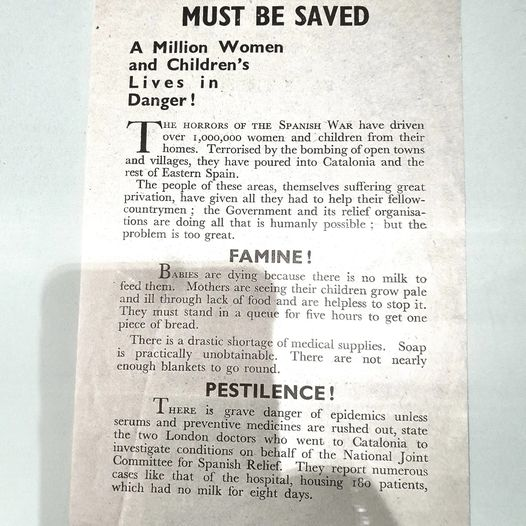
This cosy impression of the first half of the show is rather punctured by an awareness of the backdrop of the Spanish Civil War and a small leaflet on display seemed horribly contemporary:


The second half of the show had for me a note of personal nostalgia, with works by Conroy Maddox, Toni del Renzio and Tony Earnshaw, all of whom were friends. Toni del Renzio even joined the London Surrealist Group in 2005, making him by far the oldest member at 90, the youngest at that time being 16! The home video of Sherwin's visit to Conroy's flat was oddly familiar, very much like my own visit, seeing some of the same things. It also featured both Toni and Tony and Conroy's partner, Des Mogg. 

I don't want to overdo this impression of something old, warm and comfy, several works, back in the day, provoked severe reactions and demands that they should be destroyed, presumably from Daily Mail readers or their equivalent, and plenty of them still have a subversive charge and the power to disconcert, but the context of this exhibition gave me the sense that they'd been wrapped in cotton wool, the sharp edges all blunted. It's all rather nice...even when a tad naughty (Conroy's nuns etc.) 

At the same time that surrealism's past has been evoked in Bath, in Lancaster a possible future of surrealism has appeared in the form of the Lancaster Surrealist Group and their magazine "Vile Bird". 

https://lancastersurrealistgroup.wordpress.com/

 The group developed, as far as I can make out, from student societies at Lancaster University and improbable amounts of Pinot Grigio, somehow developed into an understanding of surrealism and thus to self-identify as surrealists and seek the surrealist adventure in the streets of Lancaster. The magazine is already sold out, although I think one might get electronic copies if you ask nicely.

When somebody is drawn to the orbit of surrealism, they are not there as a subordinate to the elders* of the movement, such a hierarchy is properly anathema and we meet on an equal footing. Caution on both sides is understandable, "Oh, I'm a surrealist" can mean so many things to different people and have very little to do with surrealism, so it's a bit premature to get too excited about a new group, although any new manifestation is more than welcome, and potentially something to get excited about. However, Vile Bird attracted a number of contributors outside the group, including myself, people who felt this is a worthwhile venture that we can support with some enthusiasm. I have seen so much that is so much worse than what the Lancaster group has manifested so far, and if I find that manifestation still not wholly matured or realised, I can't condescend (no, I really can't! let me finish!) given my own earliest attempts at surrealist activity and the number of people who were, nevertheless, willing to take me seriously.

My point is that we have here an activity in its early stages and that has already shown some real awareness of what surrealism is, has managed to get out there and relate to other surrealists, demonstrated knowledge and understanding and that is all rather exciting. I do feel the need to ring a note of caution, it is a new activity and in many ways still unproven and undeveloped, but their sense of rebellion is strong and their activity is growing. Given that I sometimes tend to get lost in deep deliberation on theoretical matters, I also find it refreshing to see a manifestation of surrealism that's fun! 

* Sorry, we don't have elders!


Saturday, 28 October 2023

Accepting Or Refusing Atrocity

 This seems to be quite difficult to write, not least because each time I consider it, I become so overwhelmed by a fiercely depressive mood, but mostly because it should be so easy as to not require explanation and not even need to be said, it should be obvious to all but the most warped psychopaths, but genocide is always wrong, whoever commits it.

The context is, of course, the conflict between Israel and Palestine and it fills the news as well as online comment like a baleful cloud, obscuring all reasonable debate. No doubt much of this is down to cowardice, if Israel's bombing of  Gaza were committed by any other country, it would be condemned on all sides of the Commons for instance, but the utter spinelessness of our political leaders on this matter leaves me in no doubt that they are afraid to stick to anything resembling a principle.

While really putting yourself out there, taking real risks to life and limb does take great courage, simply speaking up against genocide,wherever it occurs, while at a safe distance from the action, should be a simple matter of decency. It's simple at this level, denounce the atrocities of Hamas, denounce the retaliations of the Israeli military against the citizens of Gaza. But a campaign of intimidation is underway to prevent any such decency prevailing. A friend of mine who has done no more than speak against the revenge killings perpetrated by Israel has been told by at least a couple of people he'd considered friends that they had screen-shot his posts and "passed them on", to whom he has no idea. It's worth pointing out that he is Jewish, something I'd not normally mention with regard to him as it rarely comes up. In any case, he was not intimidated, but understandably found their attitude distasteful and upsetting.

A more serious case of intimidation occurred with the sacking of Artforum editor David Velasco for publishing an open letter supporting Palestine. The list of signatories of this letter is considerable and frequently eminent. Articles concerning the case can be found here: https://hyperallergic.com/853300/artforum-editor-in-chief-david-velasco-fired-after-gaza-ceasefire-letter/

and here: https://artreview.com/artforum-sacks-editor-in-chief-david-velasco-following-open-letter-on-palestine/

and the letter is at this link: https://www.e-flux.com/notes/571447/open-letter-from-the-art-community-to-cultural-organisations

While there's a very large number of signatories, some apparently went on to have second thoughts: https://news.artnet.com/art-world/art-world-divided-by-middle-east-petitions-2383877

I'll return to this in a moment. Not everybody felt so intimidated by the backlash: https://www.bbc.co.uk/news/uk-67246847

It's ridiculous, but it seems necessary to mention that criticisms of the actions of the government of Israel is not anti-semitism. I repeat, criticisms of the actions of the government of Israel is NOT anti-semitism. To claim it is is either very stupid or very disingenuous and only serves to create cover for genuine anti-semitism. Let's not doubt that anti-semitism does really exist, it is foul and needs to be exposed, but we should not privilege anti-semitism above other kinds of racism. Both hatred of jews and hatred of arabs is of the same fabric as any other kind of racism, especially in its most extreme and humanity-denying manifestations. The many thousands of people in the streets of London (and, I'm gratified to see, Edinburgh, and no doubt many other cities, are certainly not guilty of jew-hatred, no doubt many are jews.

I wanted to make a point about that open letter. The very first name on the list of signatories is Nan Goldin, who is, of course, Jewish and many other names, some familiar, some not so, are also obviously Jewish. I refuse to believe that they are all somehow not sufficiently Jewish, or "self-hating jews" - surely they must be sufficiently self-aware to know that some people will condemn them for what is, after all, primarily a call to our common humanity?

Perhaps it would have been wise to include a condemnation of Hamas in that letter, make it clear that Hamas is not the whole of the Palestinian people, especially the children who, we are told make up a half of the population of Gaza. Similarly, the murderous, far-right government of Netanyahu is not all of Israel, far less all jews. (It isn't so long since Netanyahu was regarded as a dangerous extremist everywhere, somebody who should never be allowed anywhere near power.) But regarding Bibi Netanyahu and Hamas, read this article in Haaretz: https://www.haaretz.com/israel-news/2023-10-20/ty-article-opinion/.premium/a-brief-history-of-the-netanyahu-hamas-alliance/0000018b-47d9-d242-abef-57ff1be90000

I do realise that finding any kind of real solution in the Middle East is very difficult, very complex and fraught with all sorts of problems that are monstrously intractable. There's hatred and a complete lack of trust on both sides. I don't have any answers, except for one. that both sides remember the other is also human and that the only alternatives to finding a reasoned and reasonable solution are either perpetual war or that one side or the other is wholly exterminated, which to any remotely normal person should be unthinkable.


(Image: Peter Kennard)


Friday, 12 May 2023

Coming Home To Painting

 This might not mean a huge amount to a lot of people, but I am starting a new painting and it is actually the second largest painting I have ever made. I only realised this the other day when I set the stretchers against what had previously been my second largest painting and it was larger by a few inches than the old work. Now, some people might wonder about how large this massive work may be and will probably be a bit disappointed to learn it is 3ft x 4ft, 36"x48" or roughly 91 x 122 cm. This isn't huge for many people and for some, used to working on a large scale, even diminutive.

However, for me it means a lot. I gave up painting in oils in 1992, when I seemed to be overwhelmed with anxiety and a kind of revulsion towards my painting every time I set foot in the studio. I could only outpace this anxiety by drawing extremely rapidly and more or less automatically. So my work for the rest of the decade, and into the early years of the 21st century were, typically, A1 sized drawings, usually on very smooth hot-pressed paper, in pencil and occasional touches of wax crayon. (See here for a couple of not wholly typical examples:http://stuartinman.blogspot.com/2013/02/my-drawings-i.html)

For several years I did very little drawing, focusing on photography, (My photography Flickr page is here: https://www.flickr.com/photos/stuartinman/) and while I found the pursuit of the strange images discovered in the streets to be well worth the effort, I was not firing on all creative cylinders while I was not painting and drawing. Then I was able to retire and move to Wiltshire with Jane and suddenly had a decent studio space for the first time in many years. Within a few weeks I had my space assembled and bought a couple of canvases and made a start.

In fact, I made a number of false starts. Fortunately, I didn't feel that old anxiety, and kept plugging on. After a few weeks I decided that I needed to come to terms with this new (for me), but ancient landscape and, by degrees, started to become a landscape painter. If I had any qualms, it was that the majority of these new works could not, in any way, be called surrealist. I have given over such a large part of my life to the surrealist vision, this seemed odd, and maybe even odder, I wasn't that bothered. I don't mean that I had dropped surrealist ideas, just that they were at most in the background of the new works, if at all, and mostly not.

I started to develop a new technique for myself, starting in acrylic, many washes over a drawing, reasserting the drawing, spattering and dripping the paint, sealing it with acrylic medium, then repeating the process, then at some point switching to oil paint. Sometimes the whole work would become so hopeless that I'd overpaint it with something else. I made a series of small paintings based on drawings from the 80s, which at least were more imagination-based, and a new version of a painting from the same period that I had sold, it is of a staircase in the house I lived in back in the late 70s, in Bloomsbury. So, it was already a memory painting back then, now, a memory of a memory. I started to play with the forms just a little, letting them not quite work. Instead of correcting proportions, just letting them be awkward and difficult to navigate, as places in a dream or a memory can be, but apparently crisp and sharply outlined, at least in part.

The new work is also a memory painting and set in Bloomsbury. I originally thought of setting it in Little Russell Street, where I lived,, but because I had conceived it, not only as something very personal around my own memories, but as a sort of homage to Balthus' great canvas Passage du Commerce-Saint-André,  and the view into Bury Place from Gilbert Place (where Austin Spare had once lived) was closer in aspect to the Parisian scene. (Near here: https://www.londonpicturearchive.org.uk/view-item?i=72884&WINID=1683926619366)

So, I have sized and primed the canvas and now need to wait a week or two before starting, letting the priming cure thoroughly. (For those interested in such things, I am using a casein priming, which I have used a couple of times on small works.)  I'm expecting the painting to take months, at the very least, probably letting each layer settle down possibly revising it for years while undertaking any number of new works as well as revising older ones. I have found that very few works simply feel finished and in adding new layers I can add to the emotional and perceptive weight of the painting as well as developing it more intellectually, it is a matter of seeing where to take it, whether a matter of slight adjustments, major revision or complete reinvention.

I have not posted any of my work for a very long time, but promise to do so in future, the lack of it really isn't down to shyness, but mostly the unfinished nature of most of it. Time for that to change?

Wednesday, 10 May 2023

Two More Reviews: Oystercatcher #20 and 'Patastrophe! #7


I received two new magazines in one week and, very superficially, they looked oddly similar, although they are quite different in many ways and both maybe quite unique.

The Oystercatcher is the brainchild, or lovechild of Ron Sakolsky and he produces it every year, officially on the First of May. 2023 brings us up to issue 20 and I really hope he continues for many more years because it is very worthwhile. Ron situates The Oystercatcher fairly and squarely within the contemporary surrealist movement and from an avowedly anarchist perspective. It contains rants, reviews and more considered articles by Joel Gayraud, Penelope Rosemont and others. There are illustrations by Janice Hathaway, Rik Lina, Steven Cline, Guy Girard and others, including a very small one by John Welson.

Welson also makes an appearance in 'Patastrophe!, a rather more significant one, taking up a whole page., along with other surrealist luminaries including Doug Campbell, Jay Blackwood and John Richardson (who also appears in Oystercatcher, so I'm sure I could have made a better segue...never mind...)

'Patastrophe! is the journal/zine of Surrealerpool, which is a sort of meeting point for varied surrealists, 'pataphysicians and others, and I must admit I originally approached it with some doubts as to what it was intended to be. Anybody who knows me or has followed this blog will know I can get a bit exercised at stuff that purports to represent surrealism but fails to understand where surrealism is coming from in any way. My feeling is that 'Patastrophe! has very little interest in representing itself as some kind of official surrealist publication and intends to remain somewhat eclectic and quite fun. It sometimes, but not always, does this well. As an interface between surrealism, 'pataphysics and general weirdness it works well enough, with some high points and few low points too. It is well produced and illustrated, occasionally suffering from a what seems to me at any rate to be a self-conscious eccentricity that grates a bit. For instance, the article "Clarimonde - A Lost Weimar Film?" is so very obviously nothing of the kind, it feels a little embarrassing in its pretence. If one is going to write a spoof, one needs to be more convincing I think. The supposed film still of Clarimonde doesn't belong to the 1920s, but very obviously shows a modern woman dressed in Goth fashion. They provide a link to the film, (Clarimonde.website) and I have to say that it is, in its own terms, a successful and poetic interpretation of a story by Theophile Gautier, constructed of still photographs, and presumably made on a zero budget.

Two profile pieces are, by themselves, sufficient to make the purchase of this issue worthwhile as far as I'm concerned, one on Arthur Adamov, absurdist playwright and occasional participant in surrealism, and Jean Ferry, an important but too little known surrealist.

There's a good deal to be gleaned from both publications, I was fascinated by Abigail Susik's interview with the anarchist Ben Morea in Oystercatcher. It is in fact Part 2, the first part published a year ago and I'd forgotten, so obviously I need to look at the previous issue. Abigail's presence is felt in a review of "Resurgence! Jonathan leake, Radical Surrealism and the Resurgence Youth Movement 1964-1967" edited by Abigail Susik and published by the Eberhardt Press. I have my copy, but have not had time to read it yet. The effect is that these two magazines have done quite a lot to keep me busy over the next few weeks as I catch up with my reading, that must be a sign of a good publication, surely?

Oystercatcher #20 can be obtained from: 

Ron Sakolsky/The Oystercatcher, A-4062 Wren Road,Denman Island, BC Sla-Dai-Aich/Taystayic, Canada V0R 1T0

email: oystercatcher@uniserve.com

'Patastrophe! #7 can be obtained from:

surrealerpool@gmail.com  or from their ebay shop: https://www.ebay.co.uk/usr/lamoncrans


Saturday, 29 April 2023

Surrealpolitik by John Schoneboom: A Review


John Schoneboom's new book Surrealpolitik: Surreality and the National Security State is by turns a frustrating, occasionally annoying, sometimes fascinating and, in concept at least, a quite necessary book, but not, to my mind, the book it should have been. Let's break this down slightly.

Frustrating because, although Schoneboom is clearly advocating a surrealist "mode of enquiry", and he obviously has some understanding of surrealism, he nevertheless falls short of developing this thesis into something really concrete. Rather, he tends to describe the "National Security State" in terms of dream, fascism and antifascism, paranoia, black humour, despite giving examples of surrealist and pre-surrealist writing, he ends in each case by suggesting that a surrealist mode of enquiry could be fruitful.

Annoying, partly because he sometimes seems to chant "National Security State" and "surrealist mode of enquiry" like mantras, which I must admit I find a bit irritating. He also seems at times to be rather uncertain as to who the surrealists are, he names Boris Vian as a surrealist for instance. As far as I know, Vian never participated in surrealist activities and never subscribed to specifically surrealist ideas. He was, of course, a prominent member of OuLiPo, which does have some connections with surrealism at  a distance, but simply can't be thought of as a surrealist group. See below for a further discussion of this problematic attitude.

Fascinating because Schoneboom provides a lens to view to contemporary political world that exposes its meanness and monstrosity and the obscuration of truth and he is often a lively and cogent commentator.

Necessary because surrealists should be writing books like this and getting them out into the world. They should be, but often are not. I include myself in this accusation. My excuse is a lack of access to publishing beyond the surrealist echo chamber, whatever its faults, Surrealpolitik addresses, if not quite the world, at least a broader public than most surrealist publications can achieve, and I am increasingly convinced that this is essential for our future. It often seems to me, not that surrealism has become too inward-looking so much as too inward-publishing and discussing, the echo-chamber I mentioned earlier.

Schoneboom seems to waver between quite a good understanding of who and what is surrealist and a confusion that depends far more on the critics (academic or otherwise) than on the surrealists themselves:

"My reference to the term "surrealism" is not intended to be limited specifically to Andre Breton's historical movement and its ever-shifting (and usually dwindling) formal membership. Rather, proceeding from the notion that "a state of mind survives" the surrealist school (Blanchot 1995 [1949], p. 85), I'm trying to locate an affinity within a more generously defined, yet still coherent, set of ideas and practices, predominantly originating in surrealist thinking but inclusive of related ideas from the movement's heirs, precursors, renegades, critics, competitors, and  usurpers."  

(http://www.surrealpolitik.org/posts/view/22) Accessed 28/4/23

He often discusses writers like Conrad or Chesterton at greater length than he does Breton or Aragon and apparently conflates Baudrillard's 'hyperreality' with surreality:

"For example, when Jean Baudrillard describes a hyperreality that "can no longer dream" because images have become indistinguishable from the real "as though things had swallowed their own mirrors" (Baudrillard 2008, p. 4), one can, without going so far as to theorize a grand unified neo-surrealism, identify a certain specular resonance with Louis Aragon's statement in A Wave of Dreams, that "[t]he only way to look at Man is as the victim of his mirrors." (2010 [1924]). (Ibid)

I also find Schoneboom's range of surrealist references oddly narrow. I found ten surrealists in a bibliography that stretches over 30 pages, and only arrived at that number by including Bataille, who although not actually a surrealist as such, did at least participate at times and helped define the surrealist spirit.  He refers to Terry Gilliam (his film Brazil) but not Jan Svankmajer, who is both surrealist and relevant to Schoneboom's arguments, but as he considers the surrealist movement a thing of the past, which, of course, it is not. Now, one might feel inclined to criticise the state of the surrealist movement, many do, including surrealists, but it has never ceased to exist, despite as Breton remarked, 'gravediggers' announcing the death of surrealism almost as soon as the Manifesto of Surrealism was published.

Schoneboom believes that "But isn't surrealism dead? Yes and no. Certainly the original movement rose, sustained itself, and fell in close parallel with the original fascist movement" (Schoneboom, 2022. P.6.) and he speaks "therefore not of resuscitating the exquisite surrealist corpse, but of adapting some of its surviving virtues in order to inform a particularly appropriate way of interrogating the incongruities and delusions of our present political condition." (Ibid. p.6). So here's the problem, claiming that the surrealist movement in non-existent is, quite simply wrong, he doesn't know what he is talking about at this point. He could claim that the present surrealist movement either lacks its historical prestige, or a cogent position on the problems of our time, or even many great artists, and one could argue about this, but he either chooses to ignore the existence of a contemporary surrealist movement that exist in continuity with the historical movement (which is to say, not a half-arsed revivalism) or he is simply ignorant.

Another problem is that although Schoneboom sets out his chapter headings with bold surrealist themes such as dreams, paranoia and black humour, much of the content appears to derive from postmodernism, which he believes "...can fairly be described as a descendent of surrealism, with both endeavours engaged principally in the disruption of semiotic systems." (Ibid. P.6) and goes on: "One suggested term for a post-postmodernist surrealism-plus-simulacra is hyper-surrealism....which has a certain appeal but may not add anything that wasn't already there. Ultimately, of course, the label is not as important as what's in the can." (Ibid. P.6) On that last point a least, I can agree, but the rest of it is pointless fluff.


It's this level of misconception that holds the book back, take out all references to surrealism and "a surrealist mode of enquiry" and you have almost the same book, a bit shorter, giving a more-or-less postmodern account of the "national security state". The latter seems to be his equivalent of the Spectacle or of the coming together of surveillance-fascism-capitalism. I'd have thought that enlarging on Debord's concept of the Spectacle would have been very relevant to Schoneboom's argument, but Debord does not appear in his bibliography and Vaneigem only as the author of the utterly wretched "Cavalier History of Surrealism" and the situationists have a stronger relationship to surrealism than most of the authors discussed in this book, despite their somewhat fractious attitude to surrealism back in the day. 

I hope I have conveyed my sense of this book being, above all, a missed opportunity. It's not that it should be an entirely surrealist account of the political problems that beset us (although, actually, why not?) but I do think that when one employs the word 'surrealism' it should mean surrealism and not something close to its opposite. (Postmodernism might be described as, in some senses as a descendent of surrealism, but, for better or worse, an illegitimate one, not only the wrong side of the blanket, but a different blanket!) By all means employ surrealist terms and concepts, but don't relabel non-surrealist concepts as surrealist. By all means go beyond the strict purview of the surrealist movement, but be clear about it, such confusionism helps nobody.

I would also suggest that although his chapter headings reflect areas of surrealist concern, they are very far from comprehensive. The ones I have mentioned, dream, paranoia and black humour are accompanied by anti-fascism and 'spectacular crime'. I have no issue with any of these, but suggest that, for a possible future project on might add desire, automatism, dialectic, analogy, wandering, atopia - I could go on, but all of these add both to an appreciation of both the surrealist view of daily life and of the bigger political picture. The National Security State is indeed oppressive and needs to be combatted, both critically and practically, but it is only one facet of a bigger problem which is why I mentioned both The Spectacle and Capitalism and all are ways in which corporations and the state come together, the very definition of fascism given by Mussolini.

Perhaps this somewhat half-arsed book can provide sufficient provocation to help develop a renewed critique from the surrealists and their allies. Anybody who reads this review should be in no doubt that it is greatly needed. 

The great thing about blog entries is that they can remain a bit rough and, if necessary, can be revised and polished later. The less good thing can be that the revision and polish can be a consequence of reactions and criticisms of the original article, and that can be sometimes sadly lacking. I hope that I might have cause to revise this, or add comments...let's see.

References:
Schoneboom, John (2022) SURREALPOLITIK: Surreality and the National Security State. Wincester UK and Washington USA. Zero Books.

Surrealpolitik website @  surrealpolitik.org


Friday, 31 March 2023

Reality, Simulation and Time

Every now and then I seem to manage to write something that makes some kind of sense and also seems rather well put...those times are too few and far between. A friend posted something about a theory about our universe being a simulation. This sort of thing is quite fashionable, of course, and versions stretch between post-modern theory to crazed conspiracies from people who took the Matrix films a bit too seriously. 

Another post was concerning time being an illusion. I am aware that the physicist Julian Barbour has called time a "well-founded illusion" which points out that to call time an illusion does not even remotely do away with time (an interview with Barbour records that he arrived for the interview late!) but the nature of time, and of reality, are, nevertheless in question.

Needless to say, I don't have the answers, but I have been asking some of the questions for sometime. Anyway, here was my response, which I think with this bit of contextual explanation, stands alone quite...not badly...

 "The thing is, except for the nutters who believe we are in the Matrix, run by shape-shifting lizards (who, oddly enough, turn out to be Jewish) while inside the hollow earth, when we are told that time is an illusion or similar, we have to attend carefully what that really means.

At some level, EVERYTHING is an illusion because we see it at a particular scale and according to our sense organs and the way our brain interprets the data.
In the case of time, it simply can't be dismissed as an illusion because it is both real and a number of illusions, depending on what you are referring to.
The imposition of quantitative time as qualitative time is the tyranny and that is what capitalism does. The revolt against clock time doesn't destroy time, but can liberate us into genuinely lived, qualitative time."

Here's another perspective:
https://www.geeksaresexy.net/2022/02/25/truth-isnt-always-the-best-option-comic/


Sunday, 26 March 2023

WHAT CAN BE DONE IN 2023?

 Regard this as an informal enquiry, as a stimulus to thought and action. In 2023 we are only one year away from the centenary of the publication of The Manifesto of Surrealism. For various people surrealism is a great success, an abject failure, a revolutionary project run into the sandbanks of art, an art or a literary movement, a continuing revolution beneath the surface of life. Most definitions see surrealism from one corner only, so, for art historians, who often seem to dominate the recording and interpretation of surrealism, see it as an art movement, still relevant or not, depending on their personal agenda, and so on. Very often, what the scholars write about has very little to do with anything surrealism has ever been or indeed is. 

Surrealists have always defined surrealism as beyond art and literature, also beyond politics and philosophy, although it has been active in all these realms. Many current surrealists do seem content to paint and write and play some games and I don't want to dismiss these activities, it would be hypocritical for me when I have very happily rediscovered painting in the last couple of years, and wouldn't even categorise much of what I produce as 'surrealist' at present. (But I hope I can say "watch this space...").

 I am deliberately trying not to over-formulate my questions at this point, but I hope I'm clear that I don't want us to be helpless at this critical time, a time in which we may perhaps already be doomed, given that governments and corporations are recklessly slow in acknowledging the environmental crisis, the political crises everywhere around us and are in any case complicit to varying extents with the worst aspects of these factors. Disaster Capitalism may destroy us all.

So my question is, what should and can surrealists be doing at this present time that is not simply making pictures and writing poems? What can we do that might make some impact on the world? Can we justify not trying to make that impact at a time when the far right threaten the world to a greater extent than any time since the 1940s? 


Sunday, 19 June 2022

Bubu Johnson Consults His Ethical Advisor


Bubu Johnson Consults His Ethical Advisor


UBU: Are we right to behave like this? Hornstrumpot, by our Green Candle, let us consult our conscience. There it is, in this suitcase, all covered with cobwebs. It is obvious that it’s of no earthly use. (He opens the suitcase.

 Enter Conscience as a big fellow in a nightshirt.) CONSCIENCE : Sir, and so forth, be so good as to take a few notes. 

 UBU: Excuse me, Sir, we have no fondness for writing, though we have no doubt that anything you have to say would be most interesting. And while we’re on the subject, I should like to know why you have the cheek to appear before us in your shirt?

CONSCIENCE: Sir and so forth, Conscience, like Truth, usually goes without a shirt. If I have donned one, it is out of respect for the distinguished audience.

UBU: As for that, Mr. or Mrs. Conscience, you’re kicking up a great fuss about nothing. Answer this question rather. Should I do well to kill Mr. Achras who has had the audacity to come and insult me in my own house?

 CONSCIENCE: Sir and so forth, to return good with evil is unworthy of a civilized man. Mr. Achras has lodged you, Mr. Achras has received you with open arms, and made you free of his collection of polyhedra, Mr. Achras, and so forth, is a very fine fellow, quite harmless; it would be cowardly and so forth, to lull a poor old man incapable of defending himself.

 UBU: Hornstrumpot, my good conscience, are you quite sure he can’t defend himself?

CONSCIENCE: Absolutely, Sir, so it would be a coward’s trick to make away with him.

 UBU : Thank you, Sir, we shan’t need you any more. Since there’s no risk attached, we shall assassinate Mr. Achras, and we shall also make a point of consulting you more frequently, for you know how to give us better advice than we had anticipated. Now, into the suitcase with you! (He closes it again.)

 CONSCIENCE: In which case, Sir, I think we can leave it at that and so forth, for today.

Saturday, 12 March 2022

SO YA WANNABE A SURREALIST? UNCOMMERCIAL BREAK

 SO YA WANNABE A SURREALIST? UNCOMMERCIAL BREAK

This is a short intermission in my series of articles to point out something I saw quite by chance, which seems appropriate...I was delighted to see a letter by my friend John Richardson that elegantly manages to admonish the commentators on the current Surrealism Beyond Borders exhibition  for their limited and almost wholly retrospective understanding of the movement, while sketching out the activities and perspectives of the movement as it exists now. 

Surrealism lives on – and can light up these dark times


The movement is contemporary, living and relevant, writes John Richardson, and shouldn’t only be seen through a rear-view mirror  


https://www.theguardian.com/artanddesign/2022/mar/11/surrealism-lives-on-and-can-light-up-these-dark-times?fbclid=IwAR3T_X-PAebfYkTuJ0pWi-Kpliis7KKR5X6mohXg9ATSRCyq5LhLnviPPVg

Congratulations also go to the Guardian for publishing this letter. All too often they have published appalling things and were complicit in 'crimes against Surrealism' with the BBC in their coverage of the Desire Unbound exhibition, the last Tate extravaganza dedicated to Surrealism. John sets the record straight regarding contemporary Surrealism's continued activity and extraordinary international reach.

Read it, it's short and to the point and might improve your day.


Sunday, 6 March 2022

SURREALISM BEYOND BORDERS: THE MEDIA - THE STORY SO FAR

 SURREALISM BEYOND BORDERS: THE MEDIA -  PART ONE, THE STORY SO FAR


I thought that a running commentary on the media attention to the exhibition might be instructive and possibly fun. Or possibly not... Most of the journalism is of a rather low order, but some has redeeming features.

Waldemar Januszcak didn't like it:https://www.thetimes.co.uk/article/surrealism-beyond-borders-tate-modern-cant-tell-good-art-from-bad-9j3cmrpk3

Sadly, you can't read the whole article without registering with the Times who want your credit card.


The Financial Times was a bit more positive, https://www.ft.com/content/5bdc6907-12f2-4323-bf4b-321d46600598
and you can read the whole thing, a bit of a mixed bag of clichés, enthusiasm and occasional insights.

The Grauniad got Adrian Searle to review it, so thankfully we don't have to endure the ignorant posturing of Jonathan Jones, the non-thinking man's non-thinking man. Searle does at least know a fair bit about art:
https://www.theguardian.com/artanddesign/2022/feb/22/surrealism-beyond-borders-review-tate-modern-london-raging-sea-strangeness

The Torygraph is surprisingly sympathetic:
 https://www.telegraph.co.uk/art/what-to-see/surrealism-beyond-borders-tate-modern-review-visionary-celebration/ 
considering that "Too often, museums demonstrate a weakness for repetitive “blockbusters” devoted to the same handful of names. It’s brave and original to try something different. This is Surrealism reanimated, unleashed."

The Mail seems to have ignored it so far...a sadly missed opportunity to excoriate 'degenerate art'?

There's a second review from the Times! One Rachel Campbell Thompson grasps a little more than Waldemar, it seems and shows a bit more enthusiasm before one hits that paywall:
https://www.thetimes.co.uk/article/surrealism-beyond-borders-review-tate-modern-x7j5xwrgf
and no bad jokes about fish either...

The Observer's reviewer felt the excitement of the show's bold ambitions, while not knowing quite enough to always be accurate. Still, not a bad review: https://observer.com/2022/01/a-cynics-fairy-tale-on-the-mets-surrealism-beyond-borders/
It's like she almost gets it: "The ultimate achievement of this exhibition is its hypnotic offering to the viewer. On my second visit, I couldn’t make it through half the exhibit in two hours. It’s an incredible achievement, exposing many to work they would never have seen otherwise. Walking through these works, we may feel thousands of tiny eyes peering back at us, asking us who holds the baton beyond the corner, and what will we do about it?"
and then slightly ruins it by saying:
"Exiting the Met, I suddenly wanted to put on riding clothes and go in search of a submarine. I wanted to unlearn anything my art teachers in strange hats ever told me and follow my psychic intuition. I looked at the horses tied up in the park and wondered if they needed a dose of the surreal as badly as I did."

If you are fed up with reading, try You Tube for an oddly unsettling - I assume CGI review of reviews: 
https://www.youtube.com/watch?v=ws1ijeXzEPk

If you want to see how your 'surreal' investments are doing, this slice of meretricious trash may beguile you with its sheer vacuousness:
https://www.youtube.com/watch?v=ZQHbPN_rGGc&t=683s
(I had not grasped just what a complete idiot Tim Marlow is. I find it rather sad to learn that he is the director of the Design Museum.)

There's also a number of reviews of the Met's iteration of the show:
https://www.youtube.com/results?search_query=surrealism+beyond+borders

More to come, I expect. Feel free to point out reviews I have missed.


Thursday, 3 March 2022

SURREALISM BEYOND BORDERS: THE CATALOGUE

 SURREALISM BEYOND BORDERS: THE CATALOGUE


It's big. It's heavy. It's complex, full of short essays, lots of references. At first it is a bit confusing, so many parts that don't always add up to a single point or refer much to each other, a sort of maze of texts and images, crowding each other out. The catalogue certainly adds a lot of polemical weight to the exhibition, but seems to pull in many different directions. Many important manifestations of Surrealism get rather short shrift in order to fit in the global reach of this exhibition.

I have already mentioned in my previous post the very minimal showing of Czech material, I saw two photographs by Styrsky, one by Reichmann, one film by Svankmajer and one painting by Toyen. There's also a very interesting essay by Krzyzstof Fijalkowksi on the 1968 exhibition Princip Slasti. This last usefully contextualises the exhibition in relation to the very important Prague Platform, but also makes clear that the exhibition, while being the ground for new debates between the Paris and Prague surrealists, after a very long enforced silence, was not an exhibition of the Czechs at all, but entirely of the French surrealists. 

Krzyzstof is a friend and, while he is best known as a scholar, with an extraordinary track record for translating and editing important, but little known surrealist texts, he also frequently exhibits as a surrealist. There are other writers here who are either active within contemporary Surrealism or are close to and friendly with the movement, such as Abigail Susik. Abigail writes on Surrealism in Chicago, sympathetically and intelligently. There's many other writers who I have never heard of, and this is actually quite heartening, as it means there's a lot of people doing new work on under-researched areas rather than ploughing the same old furrow of Paris between the wars.

The general tone is rather more sympathetic to Surrealism than many exhibitions and many researchers, while their distance to Surrealism usually remains clear. It might be to, once again, point out that this is an exhibition about Surrealism, not a surrealist exhibition, and it is also an art exhibition, not an expression of surrealist endeavour 'in the round'. But a catalogue like this could be an opportunity to set right various shortcomings of the exhibition. For instance, although Octavio Paz does get mentioned a couple of times, there's no real sense of his importance or even of the nature of his writing. One could hardly expect a great deal about him on the walls, but an exhibition about Surrealism needs to look well beyond visual work or fall into the trap of considering it to be an art movement.

 I could only find one work by Matta in the exhibition, there is a second one in the catalogue, and I wondered if I'd somehow missed a room. Jorge Camacho seems wholly absent, as both artist and as writer,  although he gets a mention as mentor to Telemaque and is included in Long Distance, along with many others such as Zeller and Wald, Cogollo and many others.

Butoh, a configuration of modern dance, traditional Japanese theatre, Artaud's Theatre of Cruelty and Surrealism, is not mentioned, despite the attention to Japanese work here, and, given that this is first and foremost an art exhibition, it is understandable that there's be nothing up on the walls, it is less understandable that an essay on Surrealism in Japan should not at least refer to it.

Like with the exhibition itself, I will come back to the catalogue and add to, and revise my comments, but for the moment it is worth saying that this scattershot method of exhibiting is probably necessary in order to display the breadth of work, but inevitable the depth of what is shown suffers. It leaves plenty of scope for many more focused exhibitions and research publications. 


Wednesday, 2 March 2022

So Ya Wannabe A Surrealist? Part 3. Surrealsplaining and 'favourite surrealist syndrome'

 So Ya Wannabe A Surrealist? Part 3. 

Surrealsplaining and 'favourite surrealist syndrome'


I thought I'd stay in grumpy mode just a little longer... It might actually be my default mode as I shuffle towards old age.

You are no doubt familiar with a term that has become popular over the last decade or so, 'mansplaining'. And if you are a woman I am sure you don't need me to tell you that it refers to a phenomenon where men all too often feel a need to explain something to a woman who has absolutely no need for that explanation, having a full grasp of the subject and in many cases being an expert on it. There seem to have been several cases where a woman scientist has been 'corrected' on her statements regarding her specialism, the field she actually works in, by a man who has a superficial knowledge of that subject, and whose source turns out to be a book that she wrote! I hate to think of it, but I am pretty sure that, at some point I must have done this myself, although certainly not with the intent to condescend so crassly, but it does happen. At best it is a failure of awareness and self-knowledge. 

Although mansplaining is clearly embedded in sexism and even misogyny, the urge to 'splain would seem to be wider, and possibly even a universal phenomenon. In the wake of mansplaining, we saw the term 'blacksplaining' emerge where white people  have found it necessary to explain to people of, primarily African, but also other ethnicities, the oppression they have experienced, apparently unaware that such explaining is, in itself, a kind of oppression, or at the very least an expression of racism, however well meaning.

When I say there is a phenomenon that I call 'surrealsplaining' I mean that it is parallel to such manifestations as mansplaining and blacksplaining and it is mostly based on the belief that an opinion has the same weight as actual knowledge. So here's the grumpy bit, my annoyance at people who think that what I might have to say on the subject of Surrealism pales into insignificance compared to an opinion gleaned from a three minute You Tube video or a review of an exhibition in a newspaper. Usually, that annoyance is mixed with amusement, and that is a blessing, otherwise I'd have exploded with rage long ago, and that would be messy. 

In a previous post I mentioned something that frequently occurs, which goes like this:

Fan: “I love X, X is my favourite surrealist!”

X: “I am not a surrealist, I don’t much like surrealism.”

Me: “X is not a surrealist”

Fan: “You are SOOO narrow-minded!”

For instance, somebody once approached me, referring to Francis Bacon in this way. But Bacon seems to have had a low regard for Surrealism, possibly, in part, because he was turned down from exhibiting in the London International Surrealist Exhibition in the 1930s. Bacon was not a surrealist, he makes scant reference to Surrealism and in general his attitudes are quite different to those of most surrealists, artistically, philosophically and politically. But the fan insists that Bacon is a great surrealist and doesn't look beyond the label being denied by the nasty man.

However, I'd like to claim a rather more nuanced attitude than simply dividing the world into those who can be labelled surrealist and non-surrealist. I think that at several levels and junctures Bacon is potentially relevant to a surrealist painter, for instance, in his use of chance (inspired partly by Duchamp) and perhaps also in how this meshes with issues of embodiment and questioning the grand tradition of painting, for instance his metamorphosis of Velasquez's 'Pope Innocent X'. 

We could also consider Bacon's long friendship with Michel Leiris, once a member of the Surrealist Group and long after with friendly relationships in that quarter, another case of not actually being a surrealist, at least formally for most of his life, but with a definite relationship to the movement, and we can even consider his work to always exist in relation to Surrealism. What can't be done is simply collapse everything into the rubric of Surrealism presented as a simplistic and easy to digest catch-all. That falsifies both the various artists, writers and political activists and falsifies Surrealism.

But to return to the issue of surrealsplaining, a large number of people do seem to want to explain their opinions with very little reference to facts of any kind. A while ago I found myself in this situation online where pointing out that I was a scholar of Surrealism elicited the response that he was referring to Surrealism, not academia, so I pointed out that I had 30 odd years as a surrealist activist, he responded that I was "acting as a gatekeeper". Thing is, I was doing no such thing, but simply pointing out that he had his facts wrong. He'd rather become abusive and accuse me of all sorts of things than consider, even for a minute, that he might be wrong.

When I started a study of philosophy years back, my tutor told us "Nobody is interested in your opinion." She was not trying to be crushingly dismissive and rude about anything we might say, but pointing out that mere opinions have no structure of argument, and what is interesting in thinking is how we might employ facts in an argument in order to support a position, or change our position in the light of new facts or a better argument. Sadly, some people never even consider such a possibility, preferring the safety of static and dead opinions. I'm sure I must sometimes be guilty of this as well, it would seem to be distressingly common throughout humanity, so why should I be immune? However, as I am aware of the issue of having an argument that might change my mind, perhaps I'm not wholly hopeless. How about you?


Tuesday, 1 March 2022

SURREALISM BEYOND BORDERS - FIRST THOUGHTS

 Surrealism Beyond Borders - First Thoughts


The back cover of the Surrealism Beyond Borders catalogue, complete with barcode

Yesterday I made my first visit to the Surrealism Beyond Borders exhibition at Tate Modern, I'll be making several more. It's an interesting idea for an exhibition that is at least partially successful, but bound by several limitations regarding the point of view from which it is organised, the choice of works and the very nature of the exhibition.

So, to start, it is an exhibition about Surrealism, not a surrealist exhibition, and this point is crucial to understand, it has been formed in official institutions and regardless of the individual positions of its curators, remains an institutional exhibition. Although it frequently refers to Surrealism's radicalism, intellectual, artistic and political, this is nevertheless filtered through the institutional view of what is acceptable.

The choice of works gives a particular viewpoint that skews the impression formed by the exhibition as a whole. This is inevitable, but nevertheless must be stressed. I think it was important to open up the work of the Egyptian surrealists, but however important they were I don't think that they were less important than the Czechs who are almost invisible here.

There are two very small photographs by Jindrich Styrsky that really work best in the book they were published in "On The Needles Of These Days" and could easily be missed here, alongside a rather lovely photo by Vilem Reichmann. Opposite, there is a film-loop of Svankmajer's "The Flat" on continuous play, and that is that, until much later on, one gets one (superb) late Toyen. So no clear impression of Surrealism in the Czech lands can be formed, and really important works and artists and thinkers are simply absent. There should  have been something by Emila Medkova. She was at the very least as important a photographer as Reichmann, and more involved in organised Surrealism. To omit all of Styrsky's painting seems very odd, surely they could have got hold of something by this absolutely essential surrealist painter? Then there's nothing by Mikulas Medek, (Medkova's husband) or Josef Istler. I could, and at a later date probably will, go on. But my point is that these are artists who are crucial to the understanding of Surrealism at an international level, and whose absence distorts the image of Surrealism, and these might be far more necessary than various artists who are included that were never surrealists, but merely influenced by surrealist art. (Several times we come across an artist who we are informed was "not actually a surrealist but...")

A number of artists among the "not actually surrealist" do add to the overall impression of the extraordinary international reach of surrealist ideas, including Filipino artists, possibly something to discuss further in a future instalment, but the greatest problem with any exhibition of Surrealism is, simply that it is an art exhibition. As one can never over-emphasise that Surrealism is not, and never was, an art movement, despite being best known for the visual work generated by the movement, nor was, or is it a literary movement, despite the vast output of poetry by surrealists. The real importance of the poetic and visual work is in pointing to the body of ideas that constitute Surrealism which get frequent mention, but by the very nature of the exhibition, can't be properly developed.

Another problem with the choice of works is that practically nothing later than 1970 is included. This reinforces the popular idea that Surrealism ceased to exist after Breton's death. But if we consider, for instance, that Svankmajer's "The Flat" was released in 1968, two years before he joined the surrealist group, all of his specifically surrealist work is excluded from the exhibition and this is a great shame. I'm not complaining about the inclusion of "The Flat", it is a great little film and fully in the surrealist spirit, but it is symptomatic of the problems in this exhibition by dint of when it was released. Referring to my earlier point, it is also a shame that the show includes nothing by Eva Svankmajerova, women Czech surrealists are only represented by the single Toyen painting, magnificent though it is, which, incidentally, was painted about 20 years after she moved to Paris.

The catalogue, which I shall discuss another day, is big and expensive (£35) and has what promises to be a number of interesting essays in it, but I noticed that there's a number of works not included in the London exhibition, unless I simply missed them, I'll have to double-check this on my next visit as this too reflects on the scope of the show and what understanding it might provide to the visitor.

I think I will have a good deal more to say, in response to further visits, reading the catalogue, and, who knows? maybe reader's comments. I'll certainly want to discuss the inevitable media circus that will surround the exhibition. So this is far from the last word from me...you have been warned...

PS: Ted Joans' "Long Distance" is almost the only work to have been begun after 1970, the final installments added after his death in 2003. Nevertheless, it reinforces that odd deadline.